
How Russia’s Defense Ministry has been reporting on the war for four years
A million Ukrainian troops “killed” and hundreds of thousands of weapons “destroyed”

For four years of war, Russia’s Defense Ministry has issued daily battlefield updates. It reports Ukrainian losses and the “liberation” of new settlements, regardless of front line movement. Verstka reviewed the ministry’s briefings and reports how many Ukrainian soldiers the ministry claims Russia has “eliminated,” how much equipment it says Russia has “destroyed,” and how those claims compare to reality.
To read future texts, follow us on Telegram
Over a million killed Ukrainian soldiers
Units of the ‘West’ group improved their tactical position. Russian forces struck personnel and equipment from two mechanized brigades, two assault brigades of the Armed Forces of Ukraine, a territorial defense brigade, and a National Guard brigade near Bohuslavka, Kurylivka, Kucheryvka, Novoplatonivka in Kharkiv Region, and Drobysheve and Yarova in the Donetsk People’s Republic.
The enemy lost up to 235 servicemen, three armored vehicles, including two U.S. ‑made HMMWV armored cars, 13 vehicles, and a Croatian-made RAK-SA-12 multiple rocket launcher. Russian forces destroyed 13 electronic warfare stations and four ammunition depots.
Since March 12, 2022, Russia’s Defense Ministry has published daily briefings on the “special military operation.” The briefings report destroyed enemy equipment, captured settlements, and allegedly destroyed Ukrainian servicemen.
On February 24, 2026, the Russian state-run news agency TASS published a loss tally based on Defense Ministry figures of over 1.5 million killed and wounded. Verstka analyzed the briefings and counted over 1.3 million “destroyed” Ukrainian servicemen. The data indicates a significant increase in reported Ukrainian losses starting fall 2023.
Analyzing the briefings
Verstka collected daily and weekly briefings from the Defense Ministry’s official Telegram channel and analyzed them with NLP methods. To count Ukrainian losses, Verstka used mentions of noun groups referring to Ukrainian personnel (“serviceman,” “AFU serviceman,” “insurgent,” “nationalist,” etc.). A predicate analysis showed the ministry uses those mentions to describe Ukrainian losses.
The ministry uses vague language that does not allow a precise conclusion about whether it reports irreversible losses that include wounded, or anything else. It uses verbs like “killed,” “destroyed,” and “eliminated.” It mentions killed and wounded in one sentence (e.g., “the enemy lost about two hundred servicemen killed and wounded”). The briefings also mention prisoners.
To count equipment losses, Verstka selected every weapon or equipment item mentioned by the ministry. Then, Verstka pulled the daily equipment losses totals published after each briefing.
Verstka did not include other ministry posts (e.g., “Main points of the day”). It analyzed only the briefings that also appear on the Defense Ministry website.
Verstka found the Defense Ministry’s personnel-loss claims noteworthy. Over four years, the ministry reported Russia “destroyed” over 1.3 million people. Meanwhile, Military Balance listed 730,000 personnel in Ukraine’s armed forces in 2025 (ground forces—500,000; navy—40,000; air force—35,000; airborne troops—45,000; special operations forces—5,000; territorial defense—100,000; drone forces—5,000; gendarmerie and paramilitary formations—260,000).
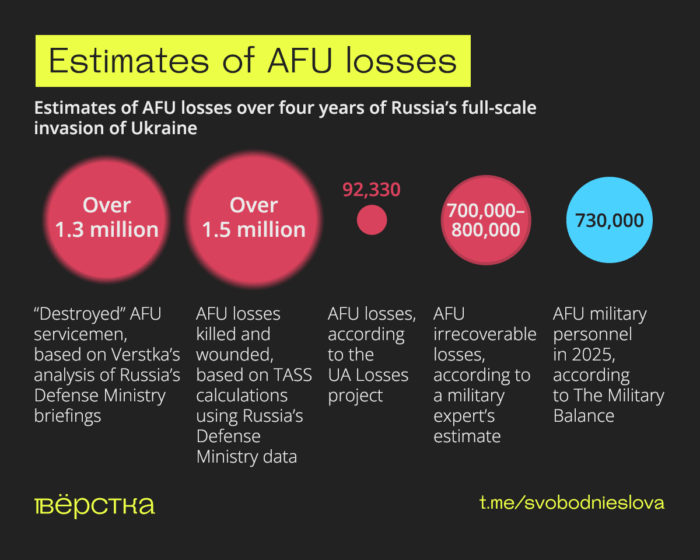
“A million roughly matches a consolidated expert estimate for total Russian losses killed and wounded (Ukraine’s General Staff cites 1,250,000),” independent military analyst Kirill Mikhailov says. “Most trustworthy estimates put Ukrainian losses at two to three times lower.”
UA Losses, which compiles open-source information about fatalities, counted 92,330 Ukrainian military deaths during the invasion. “Ukraine identifies a higher share of confirmed deaths, because the country hides that information less and keeps it more public,” one military expert told Verstka on condition of anonymity. “Volodymyr Zelensky has cited some loss figures several times, unlike Russia’s Defense Ministry, which last offered figures in September 2022.” The expert adds, “If deaths stand at around 90,000, rough estimates for missing-in-action suggest Ukraine’s real losses total about 180,000 to 200,000.”
He calls the ministry’s million-loss figure doubtful even counting irreversible losses, including severely wounded troops. The expert says, “Even rough estimates allow a confident statement that, with severely wounded included, over 700,000 soldiers have left Ukraine’s order of battle… maybe 800,000. In the first year, one could still multiply deaths by five; now that method is no longer valid.”
“Insurgents” and “nationalists”
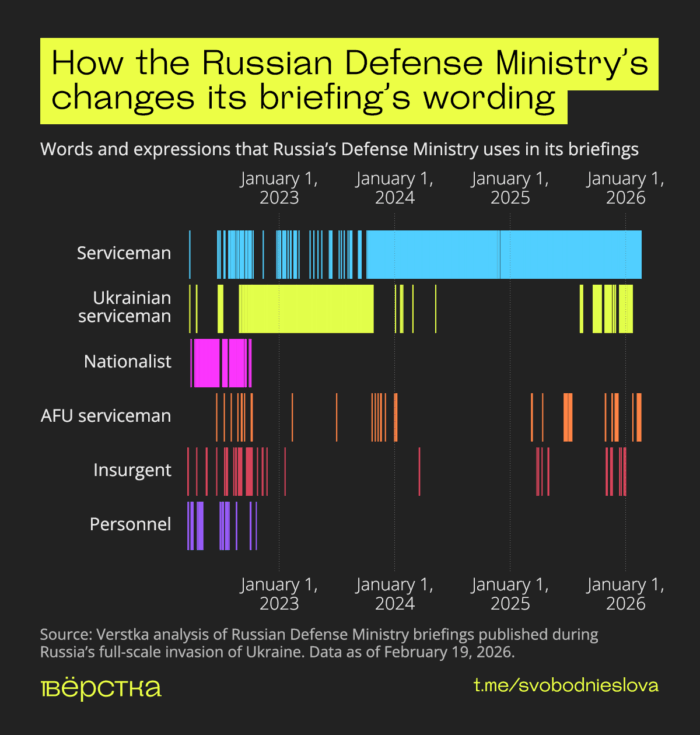
The ministry’s wording on Ukrainian troops has changed over time. The term “nationalists,” used heavily in the early war months, disappeared from the briefings. Starting in late 2023, the ministry mostly calls its opponents “servicemen.”
In spring 2025, the ministry returned to the term “insurgents,” but the term soon almost disappeared again. The ministry uses it periodically again in late 2025—for example, in the December 18 briefing:
“Russian forces stopped attempts by AFU assault groups to break through forest belts from the settlement of Shevchenko toward the northern outskirts of the industrial zone of the city of Krasnoarmiisk in the Donetsk People’s Republic. They destroyed 42 insurgents and 14 units of military equipment.”
“In the first two years, the Defense Ministry tried to mirror the ‘denazification’ rhetoric, so it brought in ‘nationalists’ and that political language of hatred,” socio-anthropologist and philologist Alexandra Arkhipova explains. “Later it replaced that language with more or less neutral words. The most frequent phrasing now looks like ‘the Defense Ministry destroyed…’ a certain number of ‘servicemen’—without mentioning Ukraine.”
Source: Verstka analysis of Russian Defense Ministry briefings published during Russia’s full-scale invasion of Ukraine. Data as of February 19, 2026.
Arkhipova says she noticed a similar trend in complaints that war participants and their families send to Russia’s human rights commissioner. “Those complaints constantly mention ‘the enemy’ in general terms, but they almost never say ‘we fight Ukrainians.’ The texts create an abstract war, and everything in that abstract war ‘goes well.’ The language legitimizes the war itself. Authors mention the word ‘serviceman,’ but they avoid mentioning Ukraine—clearly to avoid triggering certain emotions and to keep people from remembering who exactly the war targets and whom exactly the war kills.”
In late 2025, the ministry again used “Ukrainian serviceman” more actively. However, it still avoided mentioning Ukraine in many turns of phrase. For example: “The enemy lost up to 370 servicemen, a tank, an armored combat vehicle, and 18 vehicles.”
A “record” day: 1,725 fatalities
One of the ministry’s most notable days—if one trusts the numbers—came on March 20, 2024. On that day, the ministry claimed 1,725 killed Ukrainian soldiers, with the largest share on the “Belgorod direction”:
“Russian units fully cleared the settlement of Kozinka of the remaining Ukrainian insurgents and continued measures to prevent sabotage and reconnaissance groups of the Armed Forces of Ukraine from entering the border area. As a result of air strikes and artillery fire, the enemy lost up to 650 insurgents, two armored combat vehicles, and two ‘Vampire’ multiple rocket launcher combat vehicles of Czech production.”
That day brought no major shifts on the front line. Russia struck Kharkiv; the European Commission approved a proposal to use income from frozen Russian assets to support Ukraine; and Russia wrapped up its presidential vote count. The next day, March 21, authorities announced yet another victory for Vladimir Putin.
Even pro-war “Z‑patriots” and military bloggers express outrage at the scale of the ministry’s claimed Ukrainian losses. The Telegram channel “RosgVardeets” wrote, commenting on a briefing that claimed more than 4,130 Ukrainian servicemen killed in fighting on the Kursk direction: “So it turns out the enemy lost an armored battalion in just over a week of fighting. Where did they even find it, I wonder? I wonder who handles briefings at the MoD? Any proof? We talk about truth, about truthful reports, and in the end—what?”
Why did the numbers jump in fall 2023?
Around September 2023, the ministry began to report significantly larger numbers of “destroyed” AFU servicemen. Earlier, the ministry “killed” about 300 to 500 Ukrainian soldiers per day. Starting in September, the figure rose to about 1,500 per day. The ministry also started to publish weekly briefings in late August 2023. At first, the weekly totals averaged 3,000 to 4,000 “eliminated” troops. Later, the weekly totals climbed to 10,000 and more.
In late August and early September 2024, the ministry reported its highest weekly totals—two weeks in a row with nearly 17,000 per week. The record week came in the last week of October 2024, when the ministry claimed 17,054 “destroyed” servicemen.
Military analyst Kirill Mikhailov links the jump to Russia’s offensive actions, which have continued with almost no pauses since fall 2023. Mikhailov says, “Even failed attacks need justification. One can invent virtual killed and wounded enemy fighters and call it ‘grinding them down.’”
Equipment: from tanks to drones
On March 20, 2024, Defense Minister Sergei Shoigui said that since the start of 2024, Ukraine’s front-line losses exceeded 71,000 personnel and 11,000 weapons and equipment items. Shoigu’s statement suggests he relied on the same numbers the ministry publishes daily. Apparently, Shoigu counted everything the ministry listed, including drones.
By March 20, 2024, the ministry reported 15,545 destroyed tanks, 8,467 field artillery guns, 19,998 units of specialized military vehicle equipment, 1,248 multiple rocket launcher (MLRS) combat vehicles, 487 air-defense missile systems, 577 aircraft, 270 helicopters, and 16,280 UAVs. A comparison with January 1, 2024 shows the following “destructions” during that period: 1,122 tanks; 878 artillery pieces; 3,073 units of specialized military vehicle equipment; 54 MLRS vehicles; 42 air-defense systems; 12 aircraft; seven helicopters; and 5,962 UAVs. Drones accounted for more than 50% of the 11,000 destroyed items.
Shoigu also cited individual equipment categories. For example, he mentioned 11 surface-to-air missile (SAM) launchers, while the ministry’s briefings by that point claimed 42 destroyed air-defense missile systems.
In December 2025, Defense Minister Andrei Belousov said at a ministry meeting that Ukraine had lost about 500,000 servicemen and over 103,000 weapons and equipment items during the year. By that point, the ministry’s year-to-date equipment losses totals included 19 aircraft, 50 SAM systems, 6,447 tanks and armored vehicles, 129 MLRS vehicles, 11,853 field artillery guns and mortars, 19,595 units of specialized vehicle equipment, and 64,495 UAVs.
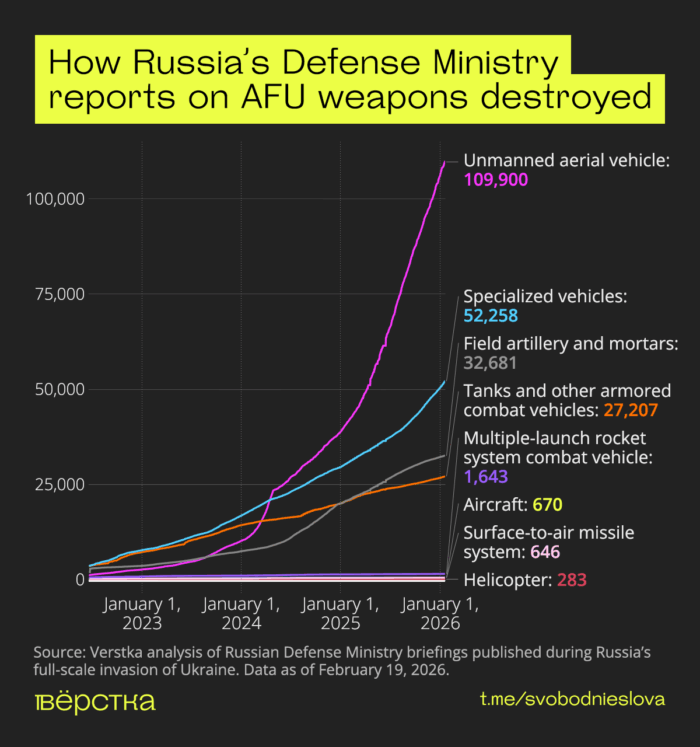
The ministry claimed 110,000 destroyed UAVs, 27,000 destroyed tanks and armored vehicles, 670 aircraft, and 283 helicopters over four years of war. Mikhailov stresses, “Even if one counts armored cars, those totals exceed by several times what Ukraine had for the entire war.” “The same problem appears across almost every category, except perhaps drones—especially if the ministry counts ordinary Mavics and FPV drones along with reconnaissance and strike fixed-wing UAVs.”
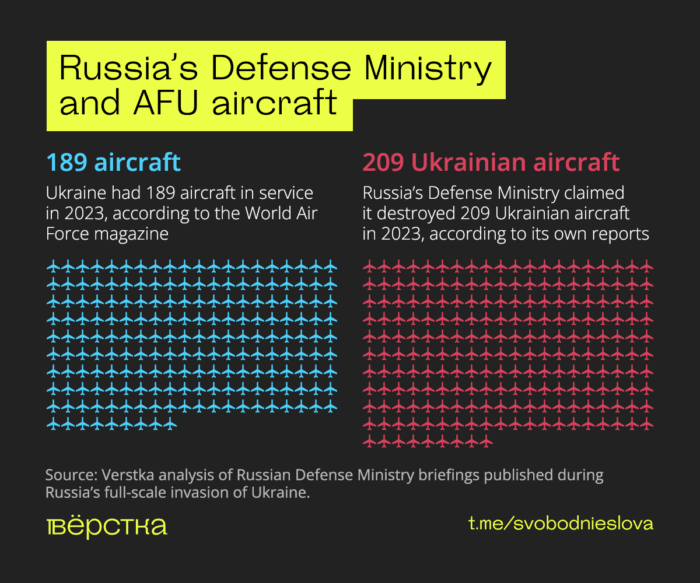
The Defense Ministry’s exaggerations stand out in its reporting of Ukraine’s aviation losses. According to World Air Force magazine, as of early 2023, the AFU had 128 aircraft (43 MiG-29s, 12 Su-24s, 16 Su-25s, 26 Su-27s, 3 An-30s, 24 An-24/26 transport aircraft, 2 Il-76s, and 2 Be-12s), and expected three An-178 deliveries. Including 61 training aircraft (47 L‑39s, 8 MiG-29s, and 6 Su-28s), Ukraine had 189 aircraft in service—yet the Defense Ministry reported 209 destroyed. As of early 2023, the AFU also had 123 helicopters (71 Mi-8s, 33 Mi-24s, 10 Mi-2s, 1 Ka-226, 4 Mi-14s, and 4 Ka-27s), while the Defense Ministry reported half of them as destroyed.
By early 2024, Ukraine again had 191 aircraft, including trainers (55 MiG-29s, 14 Su-24s, 20 Su-25s, 31 Su-27s, 3 An-30s, and 24 An-24/26 transport aircraft), plus 44 L‑39s, and expected 64 more aircraft. According to Defense Ministry briefings, Russian forces became less effective in 2024 and destroyed half as many aircraft as in the previous year—86. The number of “eliminated” helicopters also dropped sharply, with the ministry reporting only 20. World Air Force magazine put Ukraine’s helicopter fleet at 130 in early 2024 (74 Mi-8s, 33 Mi-24s, 4 Ka-27s, 1 Ka-226, 4 Mi-14s, 3 Sea Kings, and 11 Mi‑2 training helicopters).
Source: Verstka analysis of Russian Defense Ministry briefings published during Russia’s full-scale invasion of Ukraine.
Starting in late 2024, the ministry almost stopped reporting new Ukrainian aviation losses. From January 1, 2025 through February 20, 2026, the ministry “destroyed” only 20 aircraft and zero helicopters. One military expert told Verstka anonymously, “Russian aviation flies more often in daylight in warm seasons; winter brings very little flying, summer brings a lot”. “Ukraine uses fighters more for intercepting Shaheds and cruise missiles, while Russia’s Aerospace Forces use glide bombs.”
During the same period, the briefings show a sharp rise in claimed Ukrainian losses of field artillery and mortars, specialized military equipment, and tanks, while UAV-loss claims continue to climb.
By summer 2025, the Defense Ministry reported Ukrainian losses of artillery and mortars more often.
Source: Verstka analysis of Russian Defense Ministry briefings published during Russia’s full-scale invasion of Ukraine. Data as of February 19, 2026.
Mikhailov says that the trend may have real causes. He notes, “Losses of artillery and vehicle equipment can connect to expanded Russian strikes on Ukraine’s rear areas and logistics routes with drones.” He adds, “Plenty of grounds support the idea that Ukrainian losses in those categories rose around that time, though the losses likely did not rise to the levels the Defense Ministry claimed.”
Paper captures
The Defense Ministry not only reports enemy losses but also front-line advances. It often lists several “liberated” settlements at once, and may “liberate” the same place multiple times over several months.
Over time, the ministry’s claims began to irritate the pro-war audience, including military bloggers. Ivan Filippov, who runs the Telegram channel “All Quiet on the Zzzzz Western Front,” notes: “Every time, they react sharply to these ‘paper captures’i.”
For example, the channel “Pozivnoy OSETIN” commented on another “liberation” claim that was proven false:
“Comrades in uniform and the top brass of Laos (editor’s note: a common euphemism used by Russian military bloggers to refer to Russia and its Ministry of Defense), please stop reporting ‘liberations’ of settlements when the enemy still sits there. That makes no sense. It does not lift morale, it does not demoralize the enemy, it does not speed up liberation of the place, it does not create a victory in the information space, and it does not make people happier (it will, but only until the moment they learn that Laos’s warriors still fight for the village).”
Another Z‑channel, Alex Parker Returns, wrote about a different “paper capture”: “The Russian Armed Forces liberated the settlement of Minkovka in the DPR, Russia’s Defense Ministry reports. This is incorrect. Ukrainians actually hold it. After Kupiansk, someone liked ‘liberating’ everything on paper. The result sits outside the window.”
Some comments turn more aggressive. The channel “Boyevoy rezerv” wrote, “More nonsense again, Magdalynivka stands as far away as crawling to China. Why? Why the fuck lie when you haven’t even reached it?”
“I don’t rule out that Russia’s leadership relies on these numbers too, but even the ‘patriotic’ crowd treats them skeptically”, Kirill Mikhailov concludes.
Even inside the system, officials do not treat the figures that seriously. The head of one propaganda media outlet told Verstka, “At first, when the Defense Ministry and oversight bodies watched closely, we could orient ourselves only around official briefings when we informed audiences about the ‘SMO.’ Now only news desks and ‘map-makers’ watch and read them. Without an urgent need, people avoid digging into details of specific combat actions.”
A source in the government of a Siberian region told Verstka that officials “watched the briefings hard” early on. “We tried to gauge moods, to see which way the wind blew, to measure how serious everything looked. Even before the public learned that the briefings use the same event five times as a news peg, we already saw that the briefings explained nothing. Maybe a military department should report this way during a war so the enemy doesn’t learn the exact picture from firsthand statements. The military at the General Staff can sort out reality themselves, and we understand everything we need from the president’s words.”
A Verstka source close to the State Duma defense committee says deputies read the briefings in an official capacity. The source says, “I’ll stress this: deputies treat the briefings as the official position, not as a source for decisions.” The source adds that deputies can review more accurate Defense Ministry data in closed sessions.
At least one listener takes the Defense Ministry’s briefings seriously. At the Eastern Economic Forum in 2024, Vladimir Putin said:
“And finally, equally important: the enemy suffers very heavy losses in manpower and equipment. I consider the figures the Defense Ministry gives as objective because several sources confirm them… and of course, the General Staff of the Defense Ministry reports to me several times a day about what happens.”
Sometimes the ministry itself treats its own material lightly. Verstka noticed metadata on videos that the Defense Ministry uploads to Telegram. In a March 12, 2022 post about the “historic meeting of the forward units of the LPR People’s Militia, advancing on Novoaydar from the south, and the Armed Forces of the Russian Federation, moving toward it from the north,” the attached video file was named “kek” (a slang term equivalent to “LOL”).
Infographics: El
Cover: Dmitry Osinnikov
You can support “Verstka” from anywhere in the world — it’s safe, and it matters more than ever. We really need your support right now.