
“Go to your cabins, open the door, and lie on the floor”: Marinera sailors recount the tanker’s seizure
Verstka spoke with crew members of a seized Russian “shadow fleet” tanker
Almost the entire crew of the Marinera tanker, seized by the U. S. Navy in early January, was released and sent home, according to testimonies of two sailors obtained by Verstka. They said that the crew was in Scotland, first in the town of Elgin, then in Aberdeen. A few days ago, the crew received airline tickets, and today they flew home.
To read future texts, follow us on Telegram
Two Russians went to Moscow, while the Ukrainian crew will not return to Ukraine as sources told Verstka. Some of the 17 Ukrainian sailors will fly to other countries, including Moldova. Five more will voluntarily go to the United States to testify in court. They were assured that “the U. S. has no claims against them,” one of Verstka’s sources explains. The defendants in the case are the ship’s captain, Georgian citizen Avtandil Kalandadze, and his chief mate. They were arrested and taken out of Scotland aboard a U. S. Coast Guard vessel.
Kalandadze’s wife and his lawyer tried to obtain an order in a local court barring the captain’s removal from Scotland. Lawyer Aamer Anwar said the United States had “essentially kidnapped” Kalandadze. There is no information yet about the tanker’s chief mate, but Verstka’s sources claim he is a Ukrainian citizen.
The story of the seizure of a Russian “shadow fleet” tanker
On December 20, 2025, Marinera, flying the flag of Guyana, sailed through the Caribbean and headed toward Venezuela. The U. S. Navy tried to intercept the vessel. The ship refused to follow the U. S. vessels and attempted to evade them. The Wall Street Journal, citing anonymous U. S. officials, reported that Russia sent “a submarine and other naval assets” to the tanker. The 160th Special Operations Aviation Regiment carried out the seizure; the unit took part in the capture of Venezuelan President Nicolás Maduro. U. S. forces also deployed a P‑8 aircraft, F‑35 fighters, and an AC-130J gunship in close air support, because a Russian submarine operated nearby.
The U. S. Justice Department obtained a warrant to arrest the vessel because it used to transport Iranian oil, but the U. S. Coast Guard could not board. The tanker’s crew declared that Russia protected the ship and Russia entered the tanker into its national ship registry. On the day authorities detained the tanker, January 7, Russia’s Transport Ministry said Marinera had received temporary permission on December 24 to sail under Russia’s state flag, so an arrest would violate the 1982 U. N. Convention on the Law of the Sea. Russia’s Foreign Ministry said Russian citizens served among the crew and demanded that the United States return them to Russia. After U. S. forces seized Marinera, U. S. Attorney General Pam Bondi said prosecutors would bring criminal charges against crew members because the vessel carried sanctioned oil from Venezuela and Iran.
What happened on Marinera during the seizure
According to the sailors Verstka spoke with, the Marinera crew did not know the vessel was headed to Venezuela. “They said we were [going toward] Curaçao, and Curaçao, as you know, is under Dutch jurisdiction. So we approached the zone around Antigua and Barbuda. We weren’t in their territorial waters, we were standing in international waters,” sailor Konstantin (name changed at the request of the interviewee) told Verstka.
The ship began to drift, and the crew waited for information from the owner company. Another source “heard” that the vessel was headed to Caracas for a crew change, but no one officially told the tanker’s team about this. The Marinera was not carrying crude oil at the time of the seizure, Verstka’s sources note.
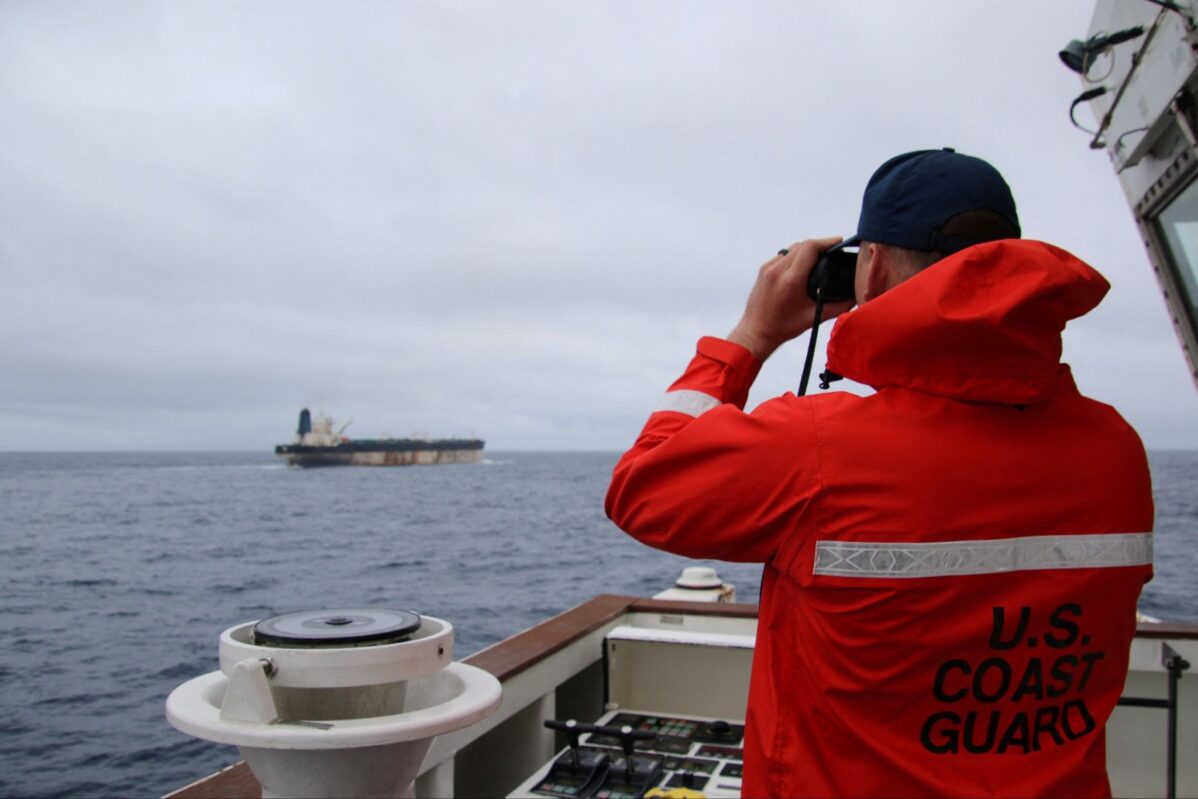
On December 20, the U.S. Coast Guard approached the tanker Marinera and requested the vessel’s documents along with a list of crew members. The crew complied with the request. “A couple of hours later, it seems the U.S. Coast Guard contacted the government of Guyana, under whose flag we were supposedly sailing. Guyana said our flag was illegitimate — that our ship was not officially registered in its database,” Konstantin said. After that, the U. S. enforcers asked the tanker to follow them, but the vessel’s operator (a logistic manager), named Kirill, told the captain to turn around and head into the Atlantic.
As one crew member told Verstka, “The captain could have turned the ship around and followed the Coast Guard, even despite what Kirill said. It would have been much simpler. There wouldn’t have been so much fuss.” Verstka was unable to locate “Kirill.” The Telegram account provided by the source had been deleted.
The captain followed the operator’s instruction and steered the tanker toward the Atlantic Ocean, Verstka’s source says. According to Konstantin, for at least two days the crew did not know a U. S. vessel was pursuing them. When Marinera began to pull away from the Coast Guard, the internet was shut off on board, and the crew was told there was a pirate attack. The crew went down into the “citadel” (a safe room), where they spent almost the entire day.
The U. S. Coast Guard repeatedly demanded that the vessel “follow them.” “From the very start of the chase they were calling us on the radio. [They said:] please follow us, you are considered a stateless vessel. But nobody answered them, and then they stopped calling us and didn’t respond to us anymore,” one sailor says. After more than a two-week chase across the Atlantic, on January 7 the United States announced it had seized the tanker.
“When the actual seizure began, <…> the captain announced over the loudspeaker that all crew members should go to their cabins, open the door, and lie on the floor, or just stand with your hands up,” Konstantin recalls.
At the same time, Russian military ships were near the tanker alongside the U. S. vessels, including a Russian submarine. “One of the [U. S.] military guys told me they acted preemptively, because if Russia’s special services had boarded, then all the Ukrainians, excuse my language, would’ve been fucked,” the man says.
By his estimate, there were 8 helicopters and 48 members of the boarding team, six people in each helicopter. U. S. military personnel boarded first, and soon after that officers from the Department of Homeland Security and the FBI appeared. They did not conduct formal interrogations, but offered the sailors the chance to voluntarily tell what they knew about the tanker, the company, and its employees, including how much they earned on the vessel.
At the same time, U. S. security service representatives seized all the sailors’ devices and locked them in a 20-square-meter canteen. “Our cook fed us; we helped him. They didn’t let us outside, but they took us to the toilet and the shower regularly,” Konstantin says. The second source noted that the entire crew slept and ate in that room.
The captain and chief mate were held separately, since they were “detained.” Twice, the sailors were allowed to send messages to relatives, but only from the enforcers’ phones. One of them allegedly was not even allowed to contact the Russian consulate.
About a day after the seizure, up to 20 law enforcement personnel remained on the ship, living in the crew’s cabins. “They [the U. S. enforcers] were happy, satisfied, and took a photo with us, like they’d successfully seized us,” Verstka’s source says.
“Everyone who was on board, I mean the U. S. military, were absolutely normal people. We became friends with them, talked calmly. They were interested in the ship, not the crew,” Konstantin recalls.
On January 14 Marinera had arrived in the Moray Firth area off Scotland’s northeast coast. “And from that moment, all the time up until yesterday [January 26], we were anchored in U. K. territorial waters and that’s it,” Verstka’s source says. The tanker was accompanied by the U. S. Coast Guard cutter Munro.
How Marinera switched to the Russian flag
Both sources noted that the Russian flag was not painted on the Marinera tanker, as some media had previously written. It was simply hoisted on the flagstaff. Konstantin says the Russian flag on the vessel was “illegitimate,” because to register under a new country the ship must first enter a port. Media outlets noted that the flag appeared on December 30. Verstka’s source says the sailors learned about the ship’s new nationality earlier. At that point, most of the team signed a petition refusing to work under the Russian flag. Verstka’s sources noted that Ukrainians signed this document.
After that, Ukrainian law enforcement officers raided homes of some of the Ukrainian crew members, Verstka’s sources claim. According to them, one of the allegations is “treason”: supposedly one crew member was recruited by Russia and passed along information that could have harmed Ukrainian citizens. Verstka was unable to find other confirmation of this information.
Who owns the Marinera tanker
Konstantin said he signed on to the ship for good money and rapid career growth. “I didn’t understand at all where I was going, what kind of company this was. They offered me a good salary, a good contract, and a good ship. It’s very promising,” he says.
When the chase began, the managers of a company called Zolos who had hired the crew deleted their chats with the sailors. The crew still has not received its January salary or leave pay (about 16% of each salary throughout the voyage, which the company withheld as a guarantee that the tanker crew member did not violate work rules). One member of the crew, a “security” person, or as one interlocutor calls him, a “snitch”, is in direct contact with the company. They were promised payment for the voyage, both sources say; one adds that monetary compensation for the incident is also planned.
The tanker Marinera seized by the United States turned out to be linked to former Ukrainian MP Viktor Baransky and fugitive Moldovan oligarch Ilan Shor. Originally called Bella 1, it belonged to the Turkish company Louis Marine Shipholding Enterprises, which is under U. S. sanctions.
But during the chase the vessel changed its name to Marinera, switched its flag to Russian, and its owner became the Ryazan-based firm Burevestmarin. It belongs to Ilya Bugai, a 39-year-old native of Chita, the investigative project Systema wrote. He runs the Russian firm Rusneftekhimtorg, which trades petroleum products.
Among the main fuel buyers were several foreign companies owned by women from Moldova. Two of them are nominees in a tanker fleet companies network with a former deputy of the Odesa City Council Viktor Baransky as the ultimate beneficial owner; Verstka previously wrote about his chain of firms. The politician was elected from the political party of Viktor Medvedchuk, known as Putin’s godfather. After the start of the full-scale war in Ukraine, Baransky was stripped of Ukrainian citizenship, and moved to Russia.
Rusneftekhimtorg is also linked to a network of companies close to Moldovan oligarch Ilan Shor, who was placed under U. S. sanctions for ties to Russia and fled Moldova.
You can support “Verstka” from anywhere in the world — it’s safe, and it matters more than ever. We really need your support right now.